
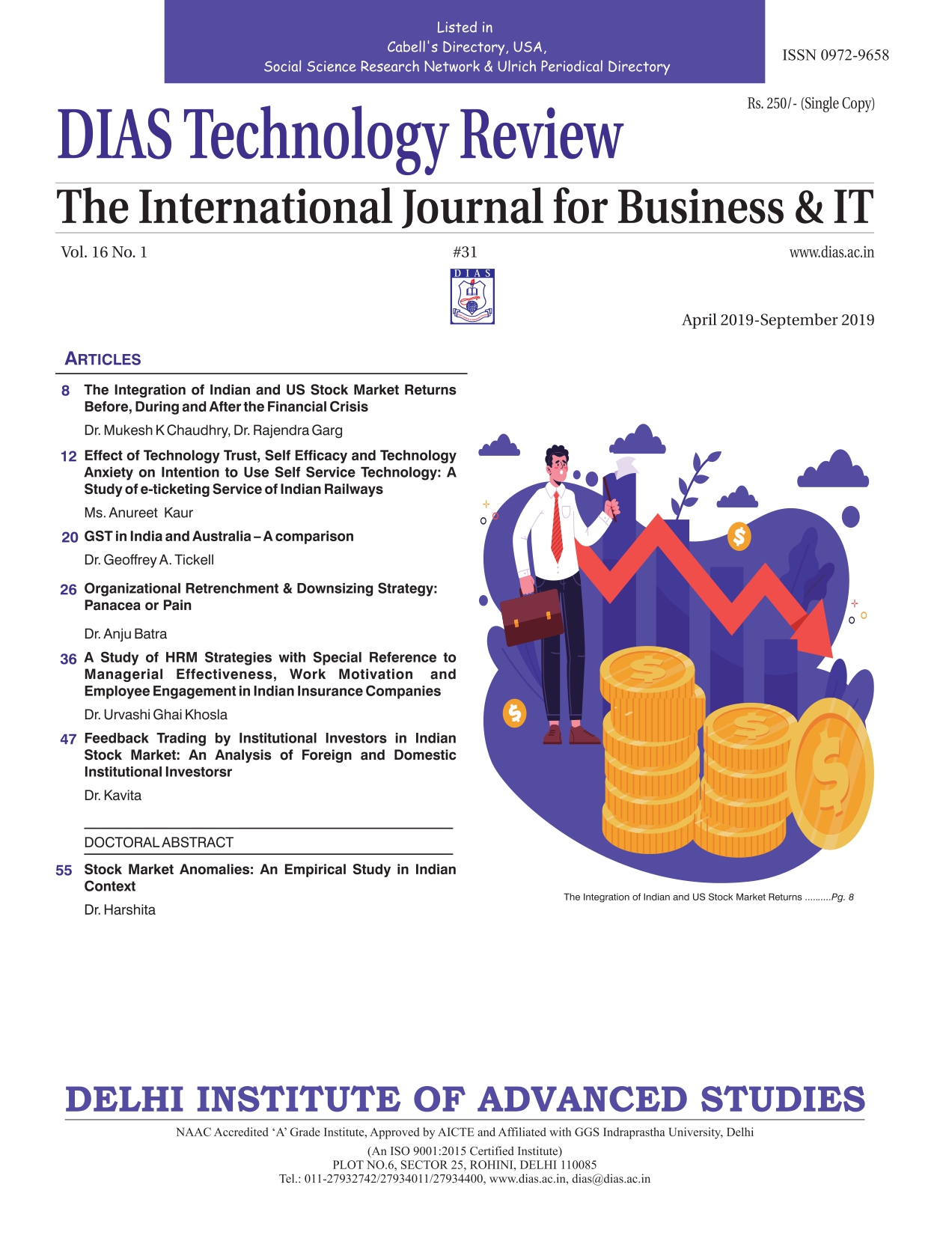

Abstract
There are significant risk reduction benefits that are available if investors create portfolios that include both US and Indian Stocks. However, during financial crisis the correlation between Indian and US stock indices is high implying that risk reduction benefits vanished when there was market turmoil. In other words, due to contagion effect levels of risk, all markets displayed steep declines with elevated
Keywords
Return
Risk
Diversification
Global Financial Crisis
Contagion
Correlations
References
- i. Angkinand, A.P., J.R. Barth and H. Kim (2010), “Spillover Effects from the U.S. Financial Crisis: Some Time-series Evidence from National Stock Returns” In G. Benton (Eds). The Financial and Economic Crises: An International Perspective, Cheltenham, UK: Edward Elgar, pp. 24–52.
- ii. Dhankar, Raj S. and Rakesh Kumar (2006), “Risk-Return Relationship and Effect of Diversification on Non-Market Risk: Application of Market Index Model in Indian Stock Market”, Journal of Financial Management and Analysis, Vol. 19, No. 2, pp. 22–31.
- iii. Frank, Nathaniel and Heiko Hesse (2009), “Financial Spillovers to Emerging Markets During the Global Financial Crisis”, Finance a UoR-Czech Journal of Economics and Finance, Vol. 59, No. 6, pp. 507–521. Retrieved from http://core.ac.uk/download/pdf/6605059.pdf
- .
- iv. Joshi, P. (2011), “Market Integration and Efficiency of Indian Stock Markets: A Study of NSE”, NSE Paper No. 198, pp. 1–29.
- v. Kulshrestha Praveen and Aakriti Mittal (2015), “Volatility in the Indian Financial Market Before, During and After the Financial Global Crisis”, Journal of Accounting and Finance, Vol. 15, No. 3, pp. 141–153.
- vi. Kumar and Mukhopadhyay (2002), “A Case of US and India”, NSE Paper No. 39, pp. 1–28.
- vii. Lamba, A.S. (2004), “An Analysis of the Dynamic Relationships between South Asian and Developed Equity Markets”, NSE Paper No. 83, pp. 1–29.
- viii. Marimuthu, M. (2010), “The Co-Movements of the Regional Stock Markets and Some Implications on Risk Diversification”, The IUP Journal of Applied Economics, Vol. 9, No. 2, pp. 61–80.
- ix. Mukherjee, K. and R.K. Mishra (2007), “International Stock Market Integration and Its Economic Determinants: A Study of Indian and World Equity Markets”, Vikalpa, Vol. 32, No. 5, pp. 5–22.
- x. Parekh, Varun (2016), “Top 3 Reasons Why The Indian Stock Market Crashed”, https://www.huffingtonpost.in/varun-parekh/top-three-reasons-why-the_b_9210142.html
- xi. Patel, Samveg (2013), “Dynamic Interdependence among Asian Equity Markets: Empirical Evidence from India”, Journal of Management Research, Vol. 13, No. 4 (October-December), pp. 219–228.
- xii. Raj, J. and S.C. Dhal (2009), “Is India’s Stock Market Integrated with Global and Major Regional Markets?”, The ICFAI Journal of Applied Finance, Vol. 15, No. 2, pp. 5–37.
- xiii. Sharpe, W.F. and G.M. Cooper (1972), “Risk-Return Classes of New York Stock Exchange Common Stocks, 1931–1967”, Financial Analysts Journal.
- xiv. Siddiqui, S. (2008), “Exploring Integration between Selected European Stock Market Indexes and Sensex”, Pranjana, Vol. 11, No. 2, pp. 79–90.
- xv. Singh, Gurmeet (2015), “The Impact of Macroeconomic Fundamentals on Stock Prices Revisited: A Study of Indian Stock Market”, Journal of International Economics, Vol. 6, Issue 2 (July–December), pp. 78–93.
- xvi. Singh, Samanjot and Manjit Singh (2016), “Investigating Impact of US, Europe, Frontier and BRIC Stock Markets on Indian Financial Stress Index”, Journal of Banking and Financial Economics, Vol. 2, No. 6, pp. 23–44.
- xvii. Singh, Shevta and Anita Makkar (2016), “Impact of Financial Crisis on the Volatility of Indian Commercial Banks’ Stock Prices”, Finance India, June 2016, Vol. 30, Issue 2, pp. 577–588.