

Abstract
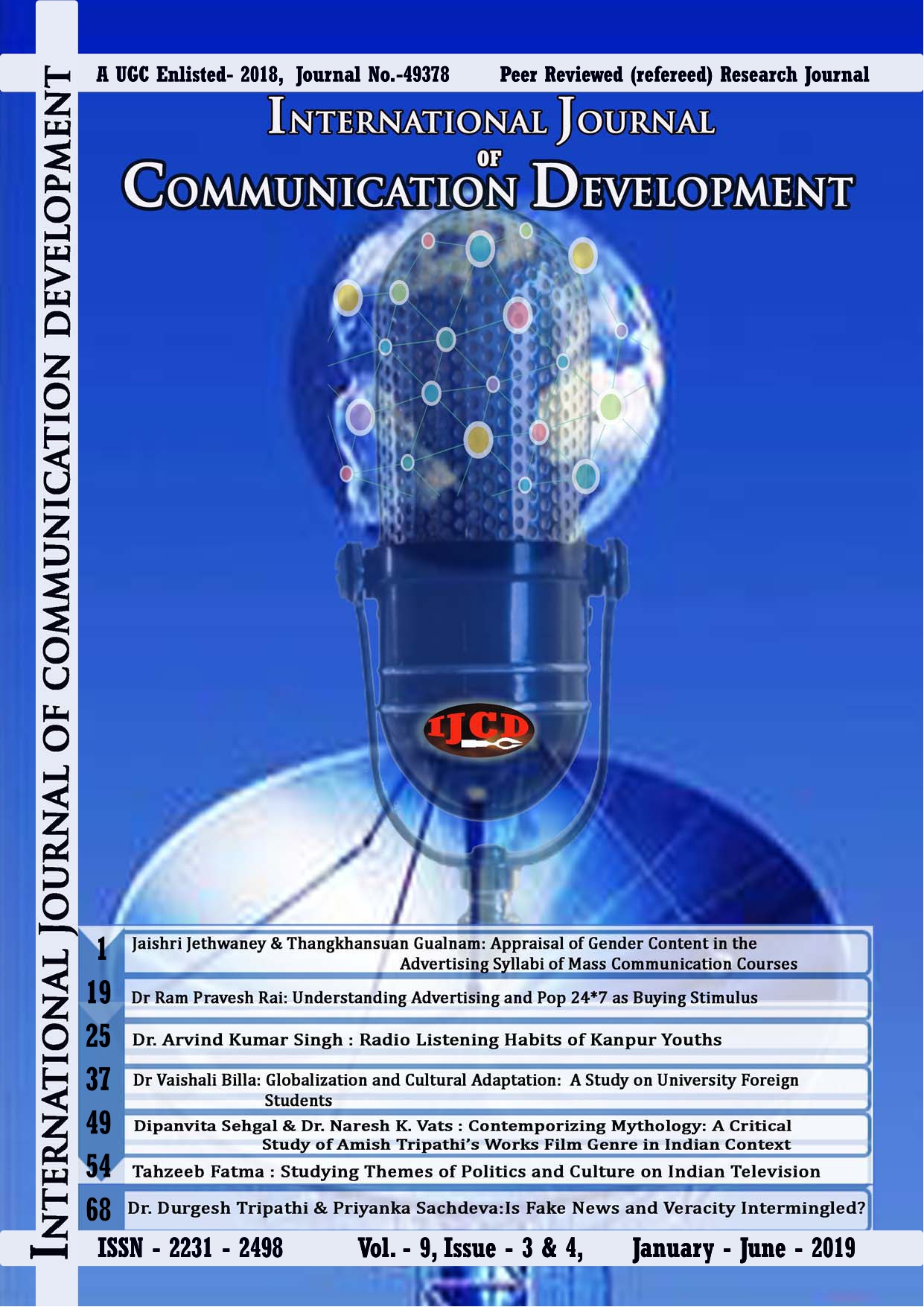
News as a narrative form relies on various codes of culture to communicate to the audience. Understanding news is not limited to what is communicates but how it does that in order to assess the real effect of news on society. Its relationship with society and its power can be studied by how news frames the issues that it communicates. Over the years Indian television has seen a revolution in the way it shares news, there is a move away from objective bulletins to a more discursive form of news debates that gather significantly more audience viewership. This research studies television news debates on Hindi television news channels to understand the complicated relationship between politics and culture in Indian news landscape. Through conducting a comprehensive frame analysis this research looks at news text and its use of culture as well as its engagement with politics that blurs the line between culture and politics while at the same time affecting the contemporary social reality.
Keywords
References
- Allan, S. (1999). News Culture. Berkshire: Open University Press.
- Anderson, B. (2006). Imagined Communities: Reflections on the Origin and Spread of Nationalism (revised ed.). New York: Verso. Baxter, L. A., & Babbie, E. (2004). The basics of communication research. Belmont: Wdsworth/Thompson.
- Boydstun, A. E., Gross, J. H., Resnik, P., & Smith, N. A. (2013). Identifying Media Frames and Frame Dynamics within and across Policy Issues. New Directions in Analyzing Text as Data Workshop. London.
- Carey, J. W. (2009). Communication as Culture: Essays on Media and Society, revised edition. Newyork: Routledge.
- Cohen, A. B. (2009). Many forms of Culture. American Psychologist , 64, 194-204.
- Cottle, S., & Rai, M. (2008). Television News in India : Mediating Democracy and Difference. International Communication Gazette , 70 (1), 76-96.
- Creswell, J. W. (2013). Qualitative inquiry & and research design: Choosing among five approaches. Los Angeles: Sage.
- Crick, B. (1964). The Reform of Parliament. London: Weidenfeld and Nicolson.
- Entman, R. (1993). Framing: Toward clarification of a fractured paradigm. Journal of Communication , 43 (4), 51-58.
- Fishman, M. (1981). Crime waves as ideology. In S. cohen, & J. young, The Manufacture of News: Deviance, Social Problems and the Mass Media. London: Constable.
- Fiske, J. (2010). Television Culture. Newyork: Routledge.
- Gamson, W. A., & Modigliani, A. (1983). Media discourse and public opinion on nuclear power: A constructionist approach. American Journal of Sociology , 95, 1-37.
- Gamson, W. A., Croteau, D., Hoynes, W., & Sasson, T. (1992). Media Images and the Social Construction oF Reality. Annual Review of Sociology , 18, 373-393.
- Gitlin, T. (1980). The whole world is watching. Berkeley: University of California Press.
- Goffman, E. (1974). Frame analysis: An essay on the organization of experience. New York: Harper & Row.
- Goodenough, W. (1961). Comment on Cultural Evolution. Daedalus , 521-528.
- Goodenough, W. (1957). Cultural Anthropology and Linguistics. In P. Garvin (Ed.), Report of the Seventh Annual Round Table Meeting on Linguistics and Language Study (pp. 32-167). Washington DC.
- Hall, S., Critcher, C., & Tony Jefferson, J. C. (2017). Policing the Crisis: Mugging, the State and Law and Order. Macmillan International Higher Education.
- Inglehart, R., & Baker, W. E. (2000). Modernization, cultural change, and the persistence of traditional values. American Sociological Review , 65, 19-51.
- Iyengar, S. (1991). Is anyone responsible?: How television frames political issues. Chicago: University of Chicago Press.
- Keesing, R. (1974). Theories of Culture. Annual Review of Anthropology , 73-79.
- Kivisto, P. (2007). Rethinking the relationship between ethnicity and religion. In J. Beckford, & N.J.Demerath (Eds.), The SAGE Handbook of the Sociology of Religion (pp. 490-510). London: Sage.
- Lasswell, H. (1936). Politics: Who Gets What, When, how. New York: Whittlesey house, McGraw-Hill book Company, Incorporated. Leftwich, A. (2004). What is Politics: The Activity and its Study. New York: Wiley.
- Manoff, R. K. (1986). Writing the News by Telling the Story. In R. K. Manoff, & M. Schudson (Eds.), Reading the news: a Pantheon guide to popular culture (pp. 197-230). Newyork: pantheon Books.
- Marx, K., & Engels, F. (1848; 1998). Communist Manifesto. New York: Verso.
- Neuman, W. R., Just, M. R., & Criger, A. N. (1992). Common knowledge: News and the construction of political meaning. Chicago: University of Chicago Press.
- Ninan, S. (2007). Headlines from the heartland: reinventing the Hindi public sphere. New Delhi: Sage Publications India.
- Odijk, D., Burscher, B., Vliegenthart, R., & Rijke, M. d. (2013). Automatic Thematic Content Analysis:Finding Frames in News. Social Informatics (pp. 333-345). Cham: Springer.
- Park, R. E. (1940). News as a Form of Knowledge: A Chapter in the Sociology of Knowledge. American Journal of Sociology , 45 (5), 669-686.
- Price, V., Tewksbury, D., & Powers, E. (1997). Switching trains of thought: The impact of news frames on Readers' cognitive responses. Communication Research , 24, 481-506.
- Priest, S. H. (2010). Doing media research: An introduction. Los Angeles: Sage.
- Reese, S. D., Gandy, O. H., & Grant, A. E. (2001). Framing Public life: Perspectives on Media and our Understanding of the Social World. New Jersey: LAWRENCE ERLBAUM ASSOCIATES, PUBLISHERS.
- Saeed, S. (2013). Screening the Public Sphere: Media and Democracy in India. New Delhi: Routledge.
- Schlesinger, P. (1978 [1987]). Putting Reality Together. Newyork: Methuen.
- Schudson, M. (1995). The Power of News. Cambridge: Harvard University Press.
- Semetko, H. A., & Valkenburg, P. M. (2000). H. A. Semetko and Framing european politics: A content analysis of press and television news. Journal of Communication , 50 (2), 93-109.
- Tankard, J. (2001). The empirical approach to the study of media framing. In S. D. Reese, O. H. Gandy, & A. E. Grant (Eds.), Framing public life (pp. 95-106). Mahwah, NJ: Lawrence Erlbaum.
- Thussu, D. K. (2007). News as Entertainment: The Rise of Global Infotainment. London: SAGE Publication.
- Williams, R. (1976). Keywords. New York: Oxford University Press.
- Zelizer, B. (2004). Taking Journalism Seriously. London: Sage Publication.